
When Should a Distributor Add a Second Automotive Electronics Category?
Use a practical go/no-go framework to decide when an automotive electronics distributor is ready to add a second product category, with evidence gates for demand, support, inventory and channel fit.
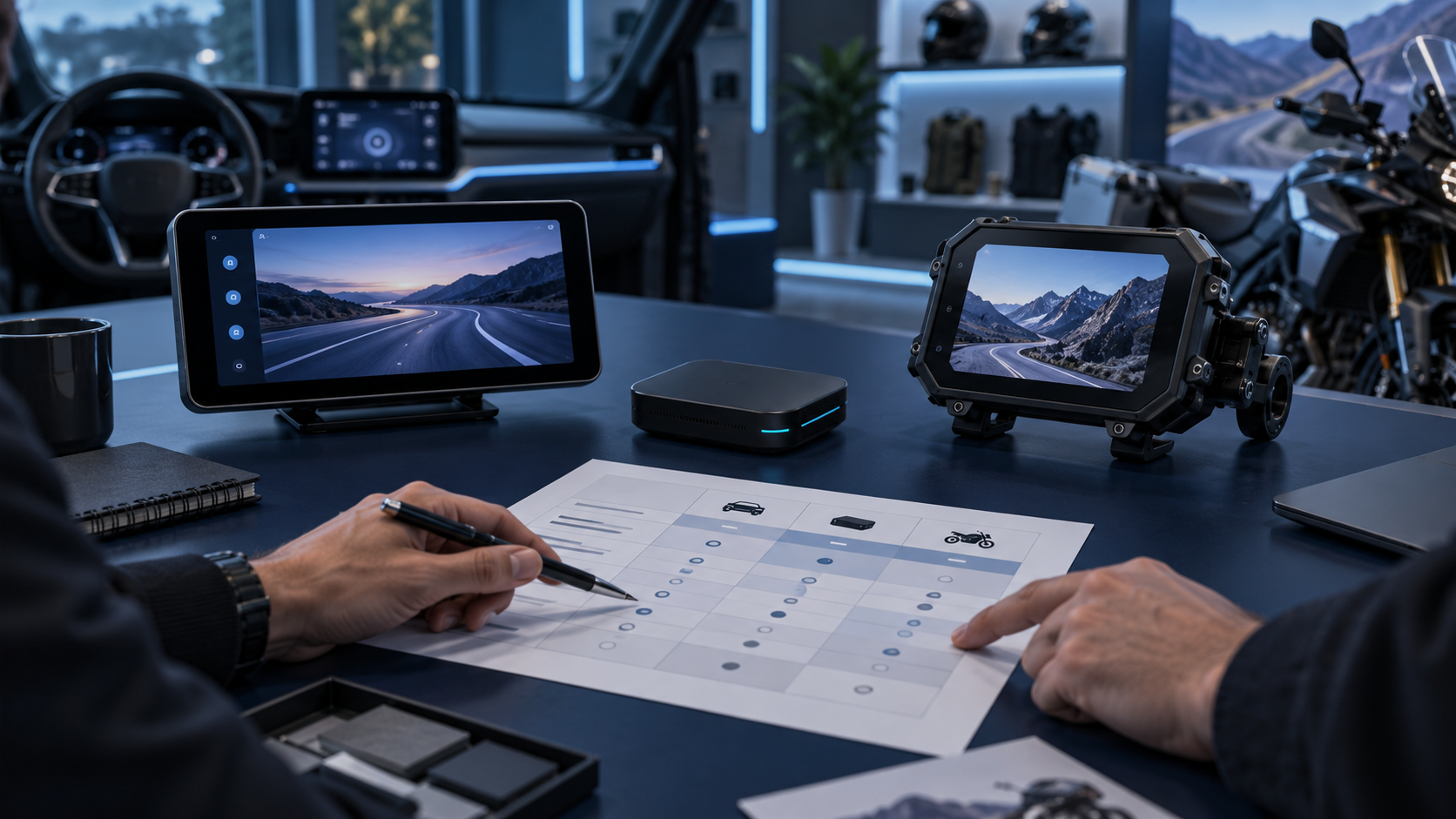
Direct answer: Add a second automotive electronics category when it solves a distinct buyer problem, existing demand evidence is visible, and your team can qualify, stock, explain, deliver and support it without weakening the first category. A new category is not ready merely because a supplier has a product or a competitor lists one. Before committing inventory, name the target buyer, define the product’s role beside the current range, verify the channel’s capability, and run a bounded pilot with explicit continue, revise or stop criteria. The decision should be made by category economics and operating readiness—not by catalog size.
This framework is for distributor leaders considering expansion from wireless CarPlay adapters into AI Boxes, portable Smart Car Screens or Motorcycle CarPlay. Unlike choosing between similar SKUs, the decision is whether the organization can operate another product system and channel promise.
What does “a second category” mean?
A product category has a distinct customer job, purchase criteria, prerequisites and support pattern. For example, a wireless adapter generally depends on factory wired CarPlay; an AI Box may add an Android-based application environment and software, network and privacy considerations. A portable screen adds display, mounting, power and audio decisions. A motorcycle display brings powersports fitment and rider-workflow questions.
These are category boundaries, not compatibility promises. Prerequisites depend on the exact SKU and use case; request a written product profile before making fitment or feature claims.
A category expansion is ready when there is an evidenced buyer problem, an explicit portfolio role, a capable route to market, a controllable operating model and an approved investment limit. If one of those is missing, the next step is evidence collection or a small pilot—not a broad launch.
Expansion is a management decision, not a catalog decision
Adding a category can serve more buyer needs or open a channel, but it can also dilute sales attention, overlap existing offers, increase support work and tie up inventory. Compare the expected contribution with the resources and risks required to earn it.
Describe the expansion in one sentence: “We are considering [category] for [buyer segment] through [channel] because [observed unmet need].” Replace claims such as “it is trending” with evidence from inquiries, lost-sale reasons, partner feedback, listing behavior or defined customer research.
Evidence does not have to be a large sales history, but it needs a source, segment and interpretation. Separate observed facts from assumptions: a few inquiries may justify interviews or samples, not automatically a large purchase order.
The five-gate category expansion framework
Use the gates below in sequence. A pass at one gate does not compensate for a critical gap at another. Record a decision owner and evidence link for each gate so that enthusiasm does not silently turn into authorization.
| Gate | Decision question | Evidence to review | Hold or revise signal |
|---|---|---|---|
| Buyer problem | Which defined buyer is asking for an outcome the current range does not provide? | Inquiry themes, lost-sale reasons, interviews, channel requests and use-case definition | Interest is generic, or the proposed category duplicates an existing job |
| Portfolio role | What distinct role does the product occupy and what should it replace, complement or avoid? | Comparison against current SKUs, price-position assumptions, prerequisites and approved claims | Sales teams cannot explain the difference without a feature dump |
| Channel readiness | Which channel can qualify, demonstrate, install or support this category? | Partner capability, listing content, training needs, lead qualification and escalation route | The channel cannot consistently explain prerequisites or handle first-line questions |
| Operating readiness | Can the distributor control configuration, inventory, quality evidence, service and change? | SKU baseline, supplier evidence, sample plan, spare parts, returns data fields and change notification process | Product versions, pack-out, warranty or ownership are unclear |
| Investment and exit | What is the bounded test, what is being measured, and what stops or scales it? | Pilot scope, cash and inventory exposure, review date, thresholds and decision authority | No owner, no stop rule, or the pilot depends on an unapproved volume commitment |
Do not turn the table into a universal numerical score. A score can conceal a blocking prerequisite. For example, strong buyer interest cannot make an undefined support boundary acceptable, and a capable sales team cannot correct a product whose intended host requirements remain unclear.
Check for a real portfolio gap
Map the existing range by customer job rather than by supplier naming. A simple map might include: wireless connection for a factory-wired CarPlay vehicle; app-based in-car functions on a compatible display; an independent display for a vehicle that lacks the desired screen experience; or a powersports display workflow. Then identify which jobs are currently served, where sales or support teams see unmet needs, and where the proposed addition overlaps.
Overlap is not automatically bad. A premium and entry option may serve different budgets or channels. But the difference must be understandable and supportable. Ask:
- Can a reseller identify the customer and vehicle conditions for each option?
- Can the customer understand why the new product is not simply a more expensive version of the first?
- Are the setup steps, connections, installation parts and service routes distinct?
- Does the proposed category improve an existing channel relationship or require a new capability?
- Would the distributor still choose this category if the supplier’s promotional claims were removed?
Write a “do not sell when” statement alongside the value proposition. Explicit boundaries help prevent expectation mismatches.
Validate the operating burden before the purchase order
For the production-intent configuration, define hardware/software identity, accessories, prerequisites, setup/reset guidance, packaging, warranty route and change owner. Request evidence relevant to intended use; a sample or certificate for another configuration does not answer every question.
Estimate the internal work by function:
| Function | Questions to answer before launch |
|---|---|
| Product and sales | What is the one-sentence role, comparison rule, qualification script and approved claim set? |
| Quality and engineering | Which sample configuration is approved, what evidence is required, and how are deviations or changes assessed? |
| Customer support | What information should first-line support collect, what can be resolved with a known procedure, and when does escalation begin? |
| Operations | How will variants, lots, accessories, packaging and replenishment be distinguished and reconciled? |
| Finance and leadership | What is the maximum exposure, review interval and authority for expanding or stopping? |
If no one can own an essential workflow, treat that as a launch dependency. A distributor may decide to build the capability, choose a different channel partner, narrow the launch, or defer the category. The purpose of the readiness review is not to force a “yes”; it is to surface the cost and control needed for a credible “yes.”
Design a pilot that answers one business question
A pilot should reduce one uncertainty. Replace “test the market” with a question: Can installers qualify portable-screen demand? Can an e-commerce listing distinguish an AI Box from an adapter? Can powersports dealers complete the supplied mount and handover process?
Define scope before samples or stock are committed:
- Segment: identify the buyer type, geography, channel and use case.
- Configuration: record the exact SKU, hardware/software baseline, accessories, packaging and sample identity.
- Exposure: set the authorized sample or inventory limit, launch dates and participating accounts.
- Measures: select leading indicators that answer the question, such as qualified inquiries, demo completion, conversion reasons, setup questions, return causes, support time, missing parts or repeatability.
- Review: set a date and owner to review the evidence, including contradictory feedback and untested assumptions.
- Decision: choose continue, revise, extend with a stated reason, or stop; record the next commitment and remaining risks.
Avoid unsupported market-size conclusions from a short pilot. Early results are directional and depend on sample selection, channel execution, seasonality and the offer shown. If the pilot is small or biased, say so. Use it to identify the next test, not to claim universal demand.
Make the go/no-go decision with explicit conditions
At the review meeting, categorize each item as supported, conditional or open. A conditional approval should name the condition, owner, deadline and evidence that closes it. Examples might include finalizing a localized manual, completing a support escalation route, confirming the production pack-out, or reviewing a sample after a hardware change. Keep a hold on commitments whose prerequisites affect safety, compatibility, material claims or product identity.
A disciplined category decision has four possible outcomes:
- Go: buyer need, portfolio role, channel, operating controls and investment authority are documented.
- Conditional go: the business case is credible, but bounded actions must close before the defined release point.
- Revise: the buyer or channel hypothesis needs a different category, scope, partner or offer.
- Stop: evidence does not support the investment or a critical readiness issue has no acceptable owner or remedy.
Stopping a weak expansion is a valid outcome. The objective is a portfolio that is easier to buy and support, not the maximum number of categories.
Common expansion mistakes
Launching because competitors list it. Competitor presence suggests a question to investigate; it does not prove your audience or support model is ready. Validate your own buyer segment.
Using a sample as production approval. Confirm the sample matches the intended configuration and review hardware, firmware, accessory or packaging changes against the approved baseline.
Treating all channels as interchangeable. Installers, retail, e-commerce and multi-tier distribution qualify and serve customers differently. Start where prerequisites can be explained and expand when training and escalation controls are repeatable.
Measuring only sell-through—or treating a pilot as scale approval. Pair sales with purchase reasons, return causes, support demand and inventory age. A pilot is bounded evidence, not automatic authorization for a larger order or broader claims; use a separate scale gate.
A one-page expansion memo
Before asking leadership to approve a new category, prepare a concise memo with these fields:
- Decision requested: research, sample evaluation, bounded pilot, first commercial order, or scale-up.
- Buyer and job: the segment, use case and unmet need.
- Portfolio role: what it complements, replaces or deliberately does not serve.
- Evidence: source, date, segment, what is observed and what remains an assumption.
- Product boundary: exact configuration, host prerequisites, accessories, claims and limitations.
- Channel and service: launch route, training, qualification, warranty, escalation and change owners.
- Exposure: spending or inventory authority, sample cap, time window and risk owner.
- Success and stop rules: measurable business and service signals that lead to go, revise, extend or stop.
- Next gate: decision date, approvers, unresolved items and required records.
Use the memo to align procurement, product, quality, sales, operations and finance; it does not replace supplier diligence.
FAQ
How many product categories should a distributor carry?
There is no universal target. Carry categories for which you can define a buyer role, qualify demand, control inventory and provide an acceptable service route.
Should a distributor add an AI Box after wireless CarPlay adapters?
Only if the target buyers want the AI Box’s distinct functions and the distributor can explain host prerequisites, software/network dependencies, privacy and support scope. Compare the exact model with current offerings and validate it on representative configurations; do not assume the category is a simple adapter upgrade.
What is the smallest responsible pilot?
The smallest pilot is the one that can answer a defined question with traceable configuration and feedback. Its size depends on the channel and variation being studied. Set the scope, exposure limit, measurements and stop rule with the responsible teams rather than using a universal unit count.
What if customer interest is clear but the support team is not ready?
Treat support readiness as a launch dependency. The distributor can build training and escalation, select a more capable pilot channel, narrow the scope, or defer the offer. Do not hide the gap behind a broad supplier promise.
Does one successful pilot justify private labeling?
Not by itself. Private labeling can introduce artwork, packaging, language, claims, configuration, quality agreements and change-control work. Reconfirm the approved baseline, local requirements, support responsibilities and economics before authorizing a branded production program.
Build the next category on evidence
For a portfolio-fit discussion, share the buyer segment, current category, proposed addition, target channel and unresolved readiness questions. TrolinkTek’s product center, distributor solutions and OEM/ODM program can help structure a product shortlist or project conversation. If you are ready to scope a specific initiative, use the project inquiry form and identify whether you want category research, sample evaluation, a controlled pilot or a private-label program.
Related reading: Connected-car product mix planning for distributors explains how to assign portfolio roles. CarPlay AI Box channel-fit scorecard focuses on channel capability for that specific category.