
Production Traceability for Automotive Electronics: From Lot ID to Field Action
Build a practical production traceability system for automotive electronics, linking supplier lots, hardware and firmware revisions, process records, shipment and field action.
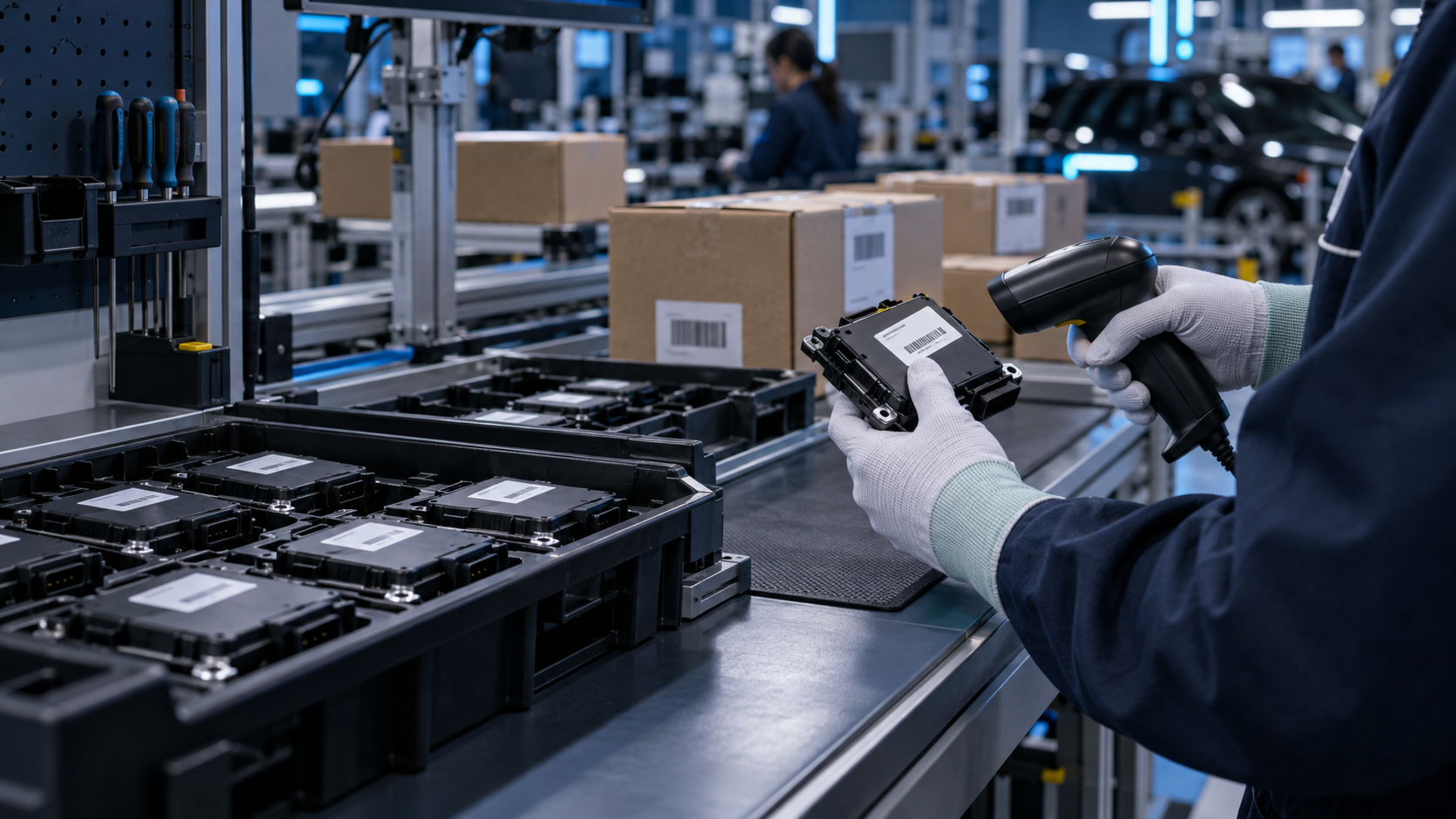
Direct answer: Production traceability for automotive electronics is the ability to connect a shipped unit or lot to the materials, configuration, process, inspection, release decision and destination records needed to investigate a quality issue. A useful system does more than print a serial number: it defines what each identifier means, captures the approved hardware and software baseline, records critical build and inspection events, preserves exceptions and dispositions, and links shipment data to after-sales feedback. Buyers should ask suppliers to demonstrate one forward trace—from a component or process lot to affected shipments—and one backward trace—from a finished unit to its relevant evidence. The required depth depends on product risk, customer agreements, markets and the supplier’s actual process; no single template or certification claim proves that a specific program is traceable.
What production traceability means
Traceability is the structured retrieval of relationships between product identity and relevant records. In an automotive electronics program, it can include a finished-device serial, production lot, SKU, hardware revision, firmware build, component supplier lot, work order, station result, rework history, pack-out revision and shipment destination. These links form product genealogy: a record of how an item was made and where it went.
The purpose is not to collect every possible data point. It is to answer bounded operational questions accurately: Which units may contain a suspect component? Which approved configuration was shipped to a customer? Did affected units pass a defined control? What stock remains quarantined? Which customers or channels need a notice, replacement or further investigation?
ISO’s public guidance explains that documented information can support process operation and provide evidence that planned work occurred. It does not prescribe one database or a universal data model. Treat the record map below as a program-design tool, then confirm applicable customer requirements and contractual scope with the quality team. ISO guidance on documented information and ISO’s QMS overview provide general context; this article is an operational guide, not a claim of certification or compliance.
The traceability chain: connect identity to evidence
Start with the questions the business must answer during release, a supplier change, a field complaint or a containment event. Then map only the records required to answer them. A practical automotive electronics model can use the following layers:
| Trace layer | Example relationship | What it helps answer |
|---|---|---|
| Product identity | Serial or lot → SKU and customer program | Which saleable product is being discussed? |
| Configuration | SKU/lot → hardware revision, firmware identifier, region and label/manual revision | What approved baseline was built? |
| Material genealogy | Work order → relevant component, PCB or packaging supplier lots | Which output could be affected by a material issue? |
| Process history | Unit/lot → assembly line, station, date/shift and approved rework | Where and under which controlled route was it made? |
| Verification | Unit/lot → defined inspection or functional result and disposition | What was checked, against which criteria, and what happened on failure? |
| Pack-out and release | Unit/lot → accessory, packaging revision, release approval and quantity | Did the shipment match the approved sellable configuration? |
| Distribution and feedback | Shipment → customer/channel and later complaint or RMA reference | Where did released product go, and what field evidence returned? |
Not every product needs a unique serial for every subassembly. Some programs can answer their risk questions using lot-level identity; others may require unit-level records for selected components or processes. The supplier and buyer should state the chosen granularity, the reason for it and any known blind spots before production begins.
Decide the right granularity before launch
Traceability adds labels, system integration, storage, training and exception-handling work. More fields do not help if identifiers are ambiguous, records incomplete or retrieval unreliable.
Choose between unit, sub-lot and lot-level records by asking:
- What failure or change are we trying to contain? A firmware configuration issue, a component lot concern and a packaging mismatch have different trace paths.
- How quickly must exposure be bounded? If the response needs to isolate a small subset, determine whether lot-level records are too coarse.
- Can the process reliably capture the link? The station, scan step or system interface must prevent silent association with the wrong work order or SKU.
- What does the customer agreement require? Contractual, market or sector-specific requirements can specify records, retention or response expectations. Confirm the applicable scope rather than assuming it.
- What information is unnecessary or sensitive? Avoid retaining personal phone names, network credentials, user accounts or diagnostic content in production trace records unless there is a documented need and an approved control.
Build the data model around a controlled baseline
Before asking for reports, define the identifiers that must join. A common failure is using a marketing name as if it were a configuration key. One product family may have multiple hardware revisions, radio modules, memory options, firmware branches, language packs, customer labels or regional kits. Record the exact attributes that change compatibility, safety, function, regulatory documentation, support or customer claims.
| Record field | Define before production | Example evidence to request |
|---|---|---|
| Identity key | Serial, lot, work order and SKU format; uniqueness and scan point | Label rule and a sample trace record |
| Baseline key | Hardware/BOM revision, firmware or image identifier, destination and document revisions | Approved baseline list and release authority |
| Material link | Which incoming lots are critical enough to link to the finished lot/unit | Supplier lot reference and receiving disposition |
| Process link | Relevant station, fixture, route and authorized rework status | Process history or traveler extract |
| Verification link | Check performed, method or fixture identity, acceptance criteria, result and failure disposition | Example inspection/test record with personal data removed |
| Release link | Who or what system authorized the lot, when and against which criteria | Release approval and hold/release status |
| Shipment link | Quantity, destination/customer reference and date or shipment record | Reconciliation from released quantity to shipped quantity |
| Record governance | Access, correction, retention, backup, retrieval and disposal rules | Procedure and an example retrieval exercise |
Select fields by risk and process relevance; agree retention with quality, legal and customer-contract owners.
Make forward and backward trace exercises part of release readiness
A supplier should be able to show both directions of a trace using a representative approved record. A forward trace starts with a suspect incoming lot, firmware baseline or process window and identifies potentially affected work orders, finished lots and shipments. A backward trace starts with a selected shipped serial or lot and retrieves its approved configuration, relevant material and process links, verification status, disposition and destination.
Use a tabletop exercise before relying on the system for a real incident. Provide a sample identifier and observe whether the quality team can retrieve the agreed evidence without relying on one person’s memory or a manually assembled spreadsheet. Record the request, the returned data, missing links, elapsed steps, authorization checks and corrective actions. Do not present an exercise as proof of response performance beyond the conditions actually tested.
For an importer or private-label buyer, a useful sample package may include:
- a redacted example of unit/lot identity and its associated configuration;
- one material-lot-to-finished-lot forward trace;
- one shipped-unit-to-build-record backward trace;
- a sample hold, rework or nonconformance disposition;
- the change-control record that identifies which baseline became effective when;
- a shipment reconciliation example and the owner of customer notification;
- the retrieval procedure, access roles and record-retention owner.
Ask for representative, approved records—not screenshots with no context. Confirm which SKU, lot, revision and customer program the examples cover, and whether the supplier is showing routine production records or a specially prepared demonstration.
Connect traceability with changes, holds and field feedback
Trace data becomes most valuable when it connects to decision controls. If a component, firmware image, station program, supplier, label or instruction changes, the change record should identify the affected configuration boundary and required validation or approvals. The approved baseline should not silently drift while old and new configurations share one label or release code.
When a check fails, preserve the original result and record the subsequent disposition: rework, retest, scrap, concession or another authorized path. A changed result should not overwrite the evidence that triggered the hold. Segregation status should be visible to people who can move, pack or release stock.
When a field complaint arrives, connect the case to the customer-reported identity and evidence available from the installed product. Then follow the agreed escalation: identify a possible common lot or configuration, assess exposure, protect remaining stock, request additional evidence where needed, and document the decision. A return or support case is not automatically proof of a systemic defect; it is an input to investigation with stated limits and sample context.
Define the ownership boundary as well. The factory may own manufacturing genealogy; the brand owner or importer may own downstream customer and channel records. Agree how a supplier request is authorized, how quickly evidence is expected under the contract, and who can approve external communication or corrective action.
Common traceability gaps buyers should look for
- A serial number with no joinable records. The label exists, but the system cannot connect it to a lot, configuration or release.
- One SKU name covering changing baselines. Hardware or firmware changes become invisible because the commercial name did not change.
- Only pass/fail summaries. There is no defined check, acceptance basis or failure disposition behind the result.
- Rework outside genealogy. Reworked devices lose their original route or are returned to stock without authorized retest and status control.
- Shipment quantities do not reconcile. Released quantity, held stock and shipped quantity cannot be explained from controlled records.
- A mock trace mistaken for routine capability. A prepared demonstration works, but routine records are incomplete or inaccessible.
- Excess data with weak governance. Logs retain personal details without a defined purpose, access or disposal rule.
Limits and non-fit conditions
Traceability supports identification and investigation; it does not by itself prevent defects, prove that an inspection was capable, establish universal product compatibility or guarantee a successful field outcome. The usefulness of a trace depends on identifier accuracy, process discipline, data integrity, representative testing and clear authority to quarantine or release product.
Automotive electronics spans products with different architectures and customer requirements. A wireless adapter, AI Box, portable screen and motorcycle display do not necessarily share the same critical components, process risks or after-sales records. Tailor the trace map to the actual SKU and intended claims. Confirm customer-specific, legal and market requirements with qualified owners; this guide does not replace an audit, quality agreement or applicable standard.
FAQ
What is the difference between a serial number and production traceability?
A serial number is an identifier. Traceability exists when the identifier reliably links to the records needed to understand the product’s approved configuration, relevant manufacturing history, release disposition and destination.
Must every automotive electronics unit have a unique serial number?
Not universally. Select unit-, sub-lot- or lot-level identity according to risk, customer requirements and the ability to contain exposure. Document where a lot-level boundary could include unaffected units.
Which production records should an importer request from a supplier?
Request a representative forward and backward trace, configuration baseline, relevant incoming-lot links, inspection/test result and disposition, rework or hold history, shipment reconciliation and the record-governance procedure. Align the exact package to the program agreement.
Does a traceability system prove ISO 9001 certification?
No. Records and traceability are only parts of a broader quality management system. Verify any certificate directly, check its stated scope and validity, and do not infer product or site coverage from a supplier’s generic statement.
How should firmware changes appear in the trace record?
Use a controlled firmware or image identifier linked to the SKU and production baseline. Record effective dates or lots, approval, validation scope and affected shipment boundary when the change can affect product behavior, support or customer claims.
Should personal device data be stored for traceability?
Only where a defined and approved purpose requires it. Production genealogy normally needs product, process and disposition links, not personal phone names, passwords or accounts. Minimize access and retention, and keep test-device cleanup separate from product genealogy.
Turn supplier evidence into a traceability review
Ask for a redacted record sample tied to a specific product family, then test the forward and backward questions that matter to your team. Review TrolinkTek’s product center, OEM/ODM capabilities and solutions to scope the product and program context. Use available downloads for supporting materials, or request a traceability evidence review with the target SKU, buyer requirements and intended trace depth.
Related guides: CarPlay AI Box pre-shipment quality control and Wireless CarPlay Adapter Control Plan: Building a CTQ Matrix.